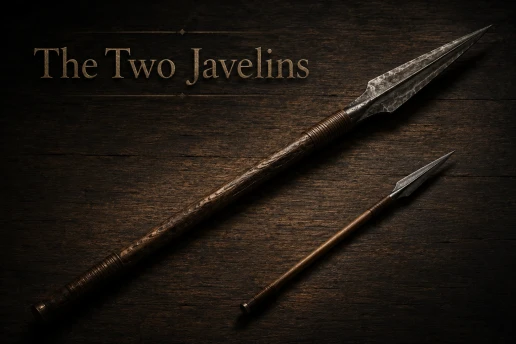
The Two Javelins
May 19, 2026 | Russ Moe
The Two Javelins
1 Samuel 16–18
David faced two challenges carrying javelins. One was named Goliath. The other was named Saul. And David responded to each of them completely differently.
That difference may contain one of the greatest lessons in spiritual wisdom found in Scripture.
Goliath’s Javelin
Goliath was the tank of his time.
Heavily armored, massive in size, and mobile with an armor bearer moving before him like an ancient military escort. Not only equipped for close combat but also with long range fire power— a javelin. Modern javelin throwers can throw nearly a hundred yards. Imagine the battlefield range of a giant warrior trained from his youth for combat. His javelin alone was enormous.
This was no symbolic enemy. This was a real threat. And David did not hesitate. Scripture says he ran toward the battle. He slung the stone, struck the giant, and cut off his head.
David was no coward. No timid shepherd boy trembling in fear. Faith made him bold.
There are enemies that must be confronted directly. There are moments for stones. There are moments for courage, forcefulness, action, and unmistakable conviction.
But then came Saul.
Saul’s Javelin
Saul also threw a spear at David. More than once.
But David answered Saul very differently than he answered Goliath.
David would not kill him—even when he had the chance.
Twice David stood over a vulnerable Saul. Twice he could have ended the torment. Twice he refused.
Why?
Because David discerned something deeper than the immediate attack.
“I will not stretch out my hand against the Lord’s anointed.” —1 Samuel 24:10
David recognized that Saul was not merely an enemy. He was a broken man. A tormented king. A leader still occupying a position God had permitted.
David could slay a giant without hesitation. But he would not touch Saul. That distinction is profound.
Wisdom Knows the Difference
Many people know how to fight. Few know when not to.
The world often thinks strength is loudness, aggression, intimidation, or retaliation. But Scripture paints a different picture.
“The more wisely David behaved himself, the more Saul feared him.” —1 Samuel 18:15
Wisdom carries a weight that fleshly aggression never can.
Men often believe the way to become feared is through insults, threats, domination, and force. But that only impresses fools. True strength behaves wisely.
David was fully capable of violence. He had already proven that. But wisdom restrained him.
He understood that not every spear thrown at you is a Goliath spear. Some are Saul spears.
And Saul spears require discernment.
The Weapons of Christ
As believers, we are taught a different kind of warfare.
“The weapons of our warfare are not carnal…” —2 Corinthians 10:4
Jesus introduced what might be called a completely different “javelin defense.”
Turn the other cheek.
Go the extra mile.
Bless those who curse you.
Do good to those who hate you.
Overcome evil with good.
Love your enemies.
These commands do not come from weakness. They come from inner spiritual might.
David understood something many of us forget: “We wrestle not against flesh and blood…” The real enemy is often deeper than the visible person throwing the spear, speaking the insult, sabotaging the opportunity, spreading the gossip.
Saul himself was tormented inwardly. David recognized it. Incredibly, David even loved him.
He honored him as king. Prayed for him. Refused to destroy him. Sympathized with his torment behind his javelins.
And eventually Saul broke under the weight of David’s mercy. At one point Saul wept openly before him.
That is extraordinary power.
Not Every Battle Is the Same
Some people only know how to throw stones. Others only know how to retreat.
David knew the difference between a Philistine and a troubled king. While refusing to retaliate against Saul personally, David was still out slaying Israel’s true enemies. He was not passive. He was discerning.
And perhaps that is the lesson. There is a time for Goliath action. There is a time to confront evil boldly.
But there’s also a time to lower the sword, duck the offense, pray for the javelin thrower, and leave judgment in the hands of God.
Wisdom knows the difference.
And perhaps spiritual maturity is learning which javelin is being thrown at us.